
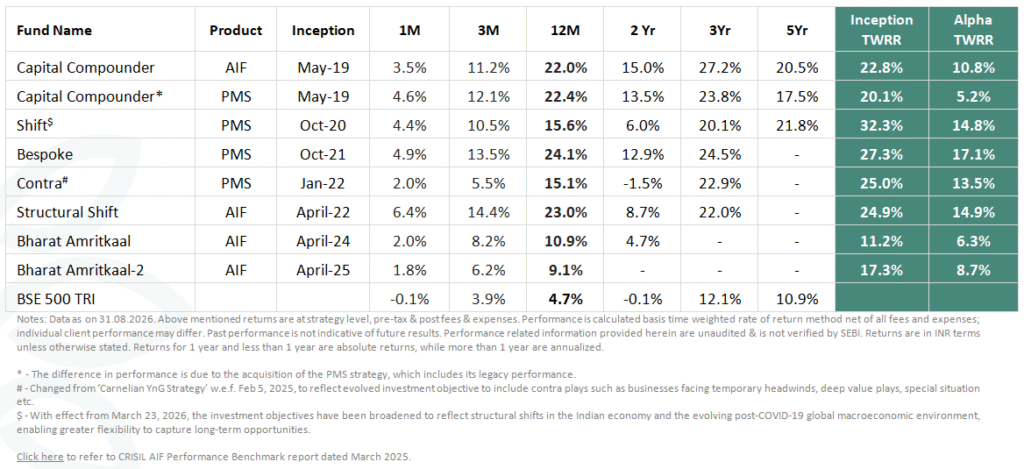
Carnelian strategies performance at a glance…
Greetings from Team Carnelian!
Most of you are aware about our MAGIC framework (read our earlier letter on it — source of alpha: revisiting MAGIC framework). It happens when a business’s earnings start growing faster than the market expects, and two things move together: earnings go up, and the multiple goes up too. That second part, re-rating, has been behind some of our best returns:
This letter is about the same thing happening in reverse – De-rating
De-rating is just MAGIC running backwards. We believe avoiding it matters just as much as finding MAGIC in the first place. This letter is about that other half of what we do.
Before we explain how this works, try guessing something. Below is a five-year price chart of a company. When it was listed in 2021, its profit was ₹267 crore. By FY26, its PAT grew to ₹943 crore — a growth of 28% CAGR – an impressive growth any investor could have asked for. The IPO was oversubscribed almost 17x. How much return do you think stock delivered?
Look at this chart
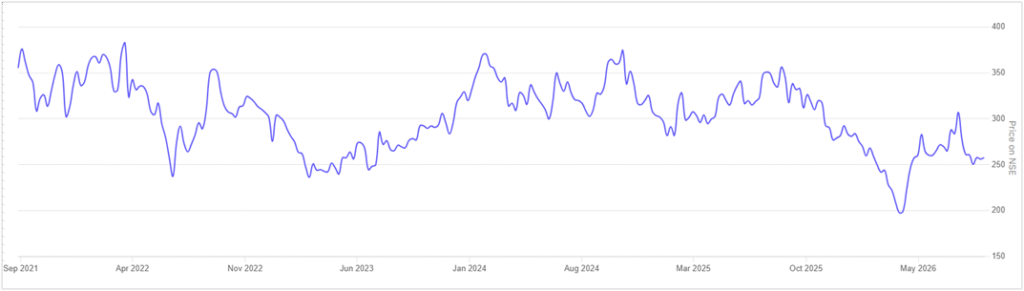
Negative 6% CAGR. Yes, you read it right. Company delivering ~28% PAT CAGR, delivered negative 6% CAGR. Let’s clarify – there was no governance issue in the company.
Here is another. HDFC Bank compounded profit at 20% between 2019 and 2026 and the stock delivered negative 5% return. We understand the pain: it is a household name and one of the most widely owned stocks in the country.
This is not a story of just one or two stocks; there are plenty!
Why does this happen? The answer is valuation de-rating.
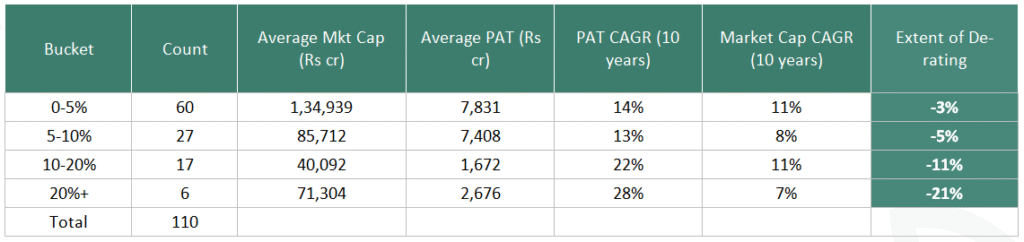
Here is the summary of companies in BSE 500 which have a trading history of more than 10 years.

Almost 40% of the companies in the above table de-rated by 5% or more, and 60% of the companies got re-rated. Which basket your portfolio falls into will decide your alpha.
Our core approach is to buy into the re-rating bucket. But finding MAGIC stories is only half the job; avoiding de-rating matters just as much, since it drags down both portfolio returns and alpha in the same way. Investors don’t always feel this as sharply as they should, and we explain why in the next section.
Averages don’t tell the full picture either. Break the same table down by how severe the de-rating or re-rating was, and a pattern shows up (as shown in the tables below): mid and small caps swing much harder in both directions than large caps do. Large caps go through the same cycle: just at a slower pace.
De-rated companies
Re-rated companies
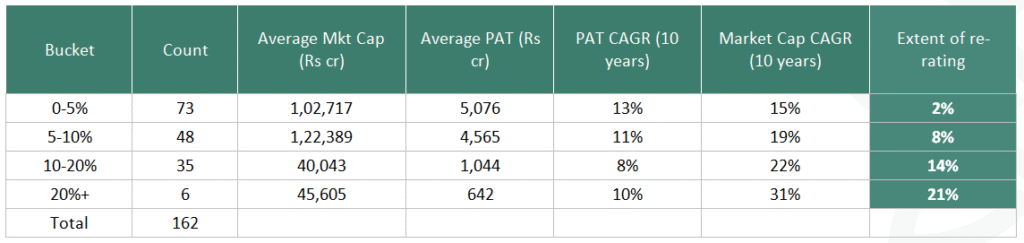
Average market cap declines monotonically as severity rises, for de-rating and re-rating tables alike. Thinner floats and lower institutional ownership let small-cap valuations swing further from earnings in either direction, making the re-pricing sharper on both good and bad news.
Let’s look deeper.
The two forces behind every stock
A stock’s price is simply: Earnings × Multiple. Two things decide the outcome, and it matters which way each one moves.
Most investors spend 80–90% of their time forecasting earnings. That makes sense — earnings are easier to predict and put into a spreadsheet. The multiple gets far less attention, even though it matters just as much. That imbalance exists because a multiple is not a mechanical function of earnings. It is function of several issues impacting the demand and supply of stock.
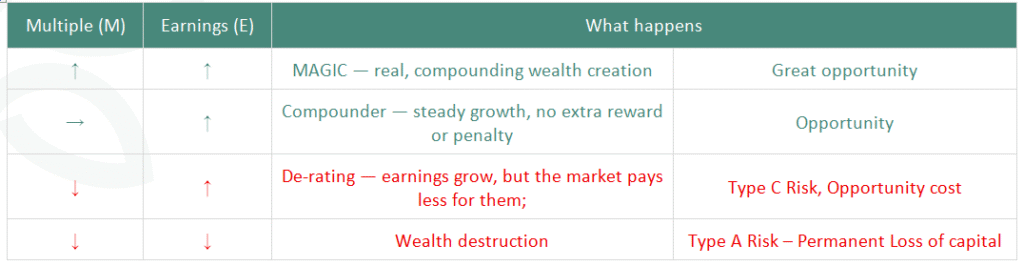
De-rating comes in two forms — a quiet one and a painful one. Only one of them shows up as an actual loss.
The quiet form: growth that goes unrewarded
This is exactly the trap behind the riddle we opened with, and most investors fall into it at some point. It has only one cause: overpaying. And investors overpay for only two reasons.
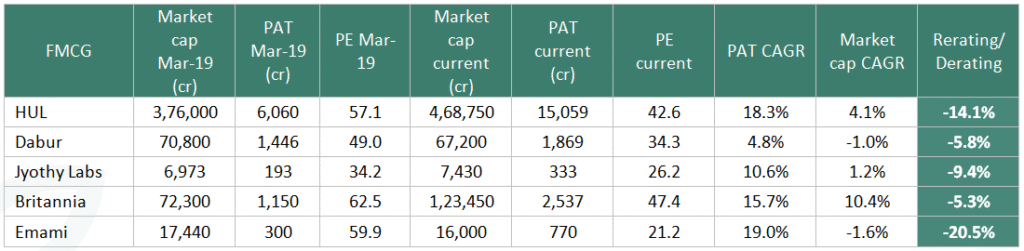
Agency bias plays a part too. Underperforming in a consensus stock attracts far less blame and so poses little threat to a manager’s career.

Bajaj HF, Medplus, Latent View — price, PAT and PE at listing vs current, and CAGR since inception
Bajaj Housing Finance carried the weight of the Bajaj name and Bajaj Finance’s history of wealth creation, making it one of 2024’s most awaited IPOs — 64x subscribed overall, over 200x in the QIB portion — and doubled on listing day. Profits have since doubled too (₹1,260cr to ₹2,560cr) but the stock is down 25% from listing.
Medplus Health Services was a rare pure pharmacy-retail listing, and demand was strong — 52.6x overall, 112x in the QIB portion. Profits have grown 3.5x since listing (₹63cr to ₹220cr). The stock still trades 18% below its issue price.
Latent View Analytics was the most hyped IPO of its time — 326x subscribed overall, 850x in the HNI portion — as the only listed pure data-analytics company. It rose over 160% on listing day. Since then, profits have more than doubled (₹91cr to ₹200cr), but the stock is down roughly 75% from its listing-day high and has generated 5% returns from the issue price.
None of these companies did anything wrong. Their profits grew as expected. Their only problem was that they were priced for that growth before it arrived, so even good results brought no extra reward.
Now, back to the earlier puzzle: 28% profit growth and a negative 6% stock return over five years. That chart was Aptus Value Housing Finance. When it listed in 2021, investors were excited — the IPO was subscribed 32 times in the QIB portion and 34 times in the NII portion, on the back of a strong South India housing-finance story. And the growth did come – profit grew from ₹267 crore to nearly ₹943 crore. But the price barely moved, because the market had already paid at listing for the growth that was still to come. Investors paid in advance for a strong performance. When the company delivered exactly that, there was nothing extra left to pay for.
The painful form: when earnings and multiples fall together
This is the kind of de-rating that actually hurts — where the multiple falls and earnings disappoint at the same time, and money is genuinely lost, not just delayed. When we look at why this happens, the reasons usually come down to one of a few things.
Competitive intensity and market dynamics change
A strong new competitor enters
Jio entered in September 2016 with months of free voice and data, permanently shifting the industry from a voice-led model to cheap data and triggering an all-out price war. ARPUs collapsed almost overnight, and revenue and profitability broke together rather than one at a time.
Vodafone Idea took the full force of it: revenue fell 20% in FY18 alone, PAT flipped from a ₹2,728 crore profit to a ₹14,604 crore loss, and its market cap fell from ₹5,85,290 crore to ₹1,73,419 crore a negative 33% CAGR. Earnings and multiple broke together, pricing in the genuine going-concern risk that eventually forced the defensive Vodafone-Idea merger. Bharti Airtel’s earnings damage was almost as severe PAT fell from ₹6,893 crore to ₹1,688 crore, a -37% CAGR but its market cap fell only -2% CAGR over the same period. The market wasn’t sparing Bharti’s multiple out of comfort; it was already pricing Bharti as the survivor of a three-to-two player shakeout, well before the earnings bottomed.
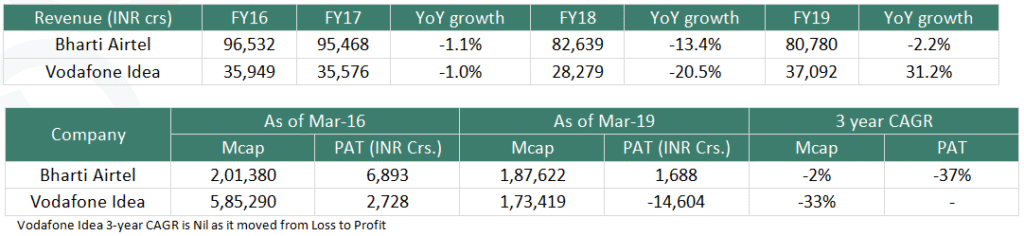
Subsequent joint tariff hikes in December 2021 (up to 21%) and July 2024 (11% to 27%) transitioned the telecom space into a stable, three-player private oligopoly.
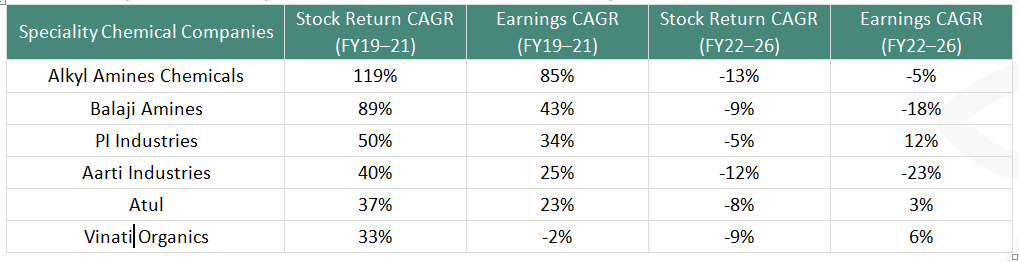
Specialty chemicals told a similar story from a different trigger. Since the 2022 peak, the sector has delivered a CAGR of under 10%.
Chinese producers, who had ceded share through Covid, came back with aggressive capacity additions and price cuts just as global customers finished running down their pandemic-era inventory. Realizations and volumes both took a hit exactly when the market had priced in an uninterrupted China+1 ramp-up.
Some of the prominent examples where maximum wealth was destroyed
Regulation that can change the business overnight
The same risk applies to businesses that depend heavily on a regulatory framework staying favorable. If that framework turns hostile, earnings deceleration and de-rating aren’t just likely — they’re close to guaranteed.
IEX shows what happens when that risk plays out. For years, it was close to a monopoly, handling 85–90% of India’s short-term power trading, and it traded at a high multiple because of that. Then the regulator proposed “market coupling” — a plan to combine all power exchanges and remove IEX’s advantage — and the stock fell more than 25% in a single day.
Trading volumes were still growing well. It didn’t matter. The market had stopped paying for a monopoly that was about to end.

ITC is a similar story, but with even less warning. Cigarettes make up about 40% of ITC’s revenue and 75% of its profit — perfectly fine, as long as taxes stay stable. And they did, for years. Then the tax structure changed early 2026, and both profits and the stock price fell almost immediately.

ITC — market cap and PAT, before and after December 2025 excise change
Governance / trust breakdown
Some de-ratings have nothing to do with the industry at all — they happen when the market simply stops trusting the numbers, or the people behind them. Zee Entertainment is the clearest case: aggressive accounting, related-party transaction concerns, a SEBI investigation, and the collapse of the Sony merger did more damage to the multiple than any OTT-linked viewership decline. Once governance trust breaks, the de-rating rarely reverses on a good quarter — the market needs years of clean conduct, not clean earnings, to underwrite the multiple again.
Other examples are PC Jeweller (promoter pledging and fund diversion concerns), Manpasand Beverages (accounting irregularities), DHFL/Yes Bank (balance sheet concealment). In each, the underlying demand for the product barely mattered — the stock re-rated down because the market could no longer underwrite management’s word.

Big acquisition or major capex
The market does not pay for growth. It pays for growth that earns more than it costs. So, when a company commits a large part of its balance sheet to a single acquisition or a heavy capex programme, the multiple often falls well before the earnings do, because three things happen at once. Return on capital drops, since the money has been spent but is not yet earning. Debt rises, so the risk sitting on the equity rises with it. And the market loses its anchor: a business it thought it understood becomes a bet on management’s capital allocation instead.
Hindalco’s purchase of Novelis and Tata Steel’s purchase of Corus in 2007 are the classic cases, where the stocks collapsed and didn’t recover for a very long period.
More recently, when Sheela Foam acquired Kurlon, a company of nearly its own size, the stock lost close to 50% of its market cap and has yet to recover.
Heavy capex weighs on the stock the same way. When a company goes through a disproportionate capex cycle, it creates stress on earnings growth, and the market de-rates the stock until that risk has passed.
This doesn’t mean capex is bad. Reliance went through a de-rating during 2007–2012, while it was investing heavily and building out new businesses, and re-rated once the earnings started showing up. That’s exactly the point: a large capital commitment takes away the market’s certainty, and the multiple contracts while that certainty is missing. When the earnings arrive, the multiple comes back.
Why the market misses this
This isn’t a new problem — it’s the same reason the market is often slow to spot MAGIC too, just in reverse.
The answer lies in two things: knowledge gaps and behavioural biases. Knowledge is the easier one to fix. Behavioural biases run much deeper and they’re what really separates successful investors from the rest.
Investors tend to:
How we approach it
For us, finding MAGIC (stocks which can deliver both earning growth and valuation re-rating) is our primary approach. But avoiding de-rating matters just as much, because a rupee saved from a falling multiple is worth the same as a rupee earned from a rising one.
If MAGIC is about believing in change early, avoiding de-rating is about noticing when belief has gone too far ahead of reality and having the humility to step back before the market figures that out on its own.
At times, this means we will miss a big opportunity. But investing is about protecting capital and taking favourable risk-reward calls — not chasing every story.
We try to stay ahead with knowledge and stay disciplined about fighting our own biases, so we don’t fall into these traps. Some of our early bets (manufacturing) and some of our de-rating avoidances (HDFC Bank, new-age stocks) came from following this approach.
Avoiding de-rating isn’t just about staying away from expensive sectors. It’s about understanding what causes de-rating in the first place.
Finding MAGIC stocks is our goal, avoiding de-rating is our discipline. Thank you, as always, for walking this journey with us. Your support and trust mean a lot to us.