
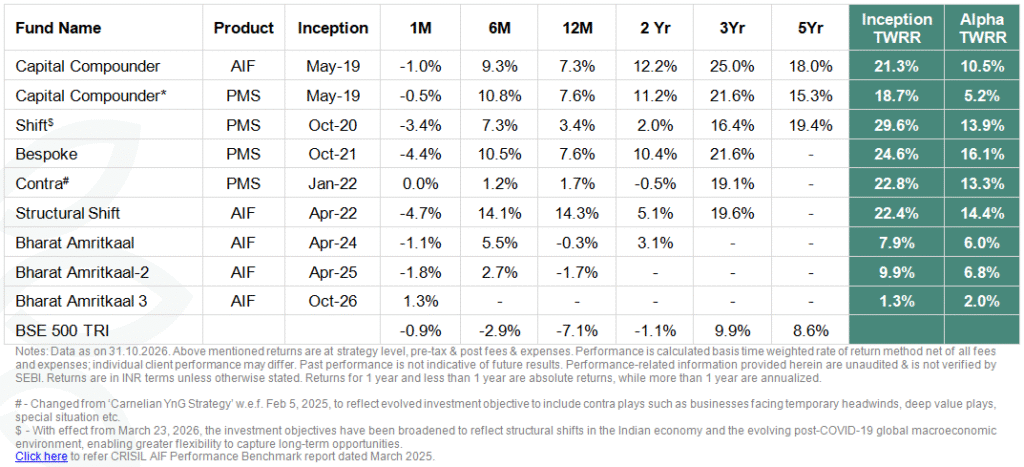
Carnelian strategies performance at a glance…
Greetings from Team Carnelian!
Wishing you and your family a happy and prosperous Diwali.
The Hanuman who forgot his strength
In the Ramayana, the search for Sita brings the vanar army to the southern tip of India. In front of them lies an endless ocean. One by one, the warriors look at the waves and say the same thing: it is too far, the risk is too great.
Hanuman, the one warrior strong enough to make the leap, sits quietly at the back.He has forgotten his own strength.
It takes the wise old Jambavan to walk up to him and remind him who he is. Hanuman rises, grows to his full size and crosses the ocean in a single leap. The ocean never got smaller. Hanuman simply remembered his strength.
Indian equities spent Samvat 2082 sitting on that shore. The ocean of bad news looked endless, and like Hanuman, the market seems to have forgotten the strength it carries within: an economy that kept getting stronger all year. Even if Lord Hanuman can forget his strength amongst all the noise, we are only humans 😉
This letter is our attempt to play Jambavan.
The ocean: a year of bad news
For two years, investors have lived with a steady stream of bad news, volatile headlines and portfolios that have gone nowhere. Samvat 2082 threw almost everything at Indian markets at the same time:
The result was weak sentiment and a Nifty that is down by 2.6% for the last Samvat 2082. But notice something about that list: every item on it is an external factor. None of them describes the Indian economy. And over any meaningful stretch of time, it is the economy, and the businesses within it, that the market has to answer to.
In our view, the market has given far too much weight to short-term headlines and almost none to improving structural strength. In this letter we uncover divergent factors of the market sentiments and economy.
The strength: what the headlines missed
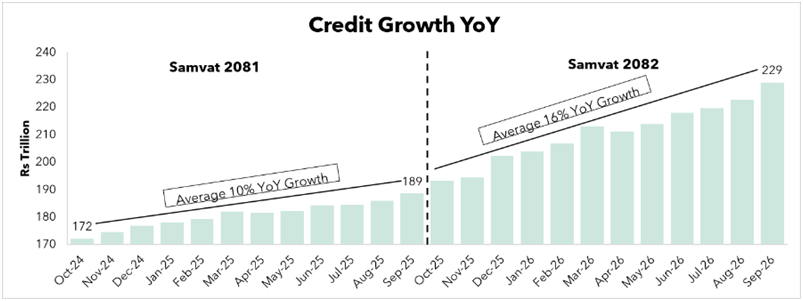
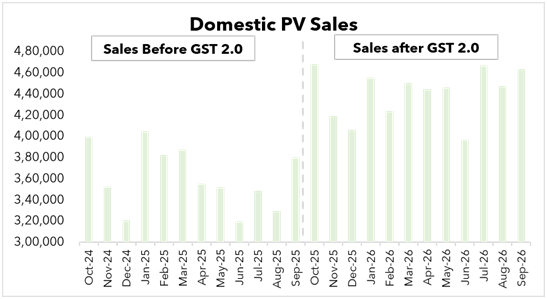
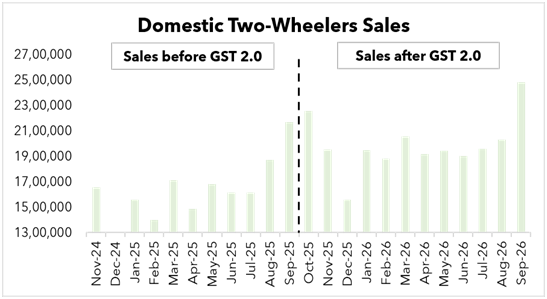
Beneath the noise, the Indian economy kept getting stronger. Private capex is picking up, tax collections are strong, auto numbers are good, consumption is growing, credit growth is strong and corporate balance sheets are in good shape. After years of tight liquidity, credit is flowing again. GST 2.0 has put money back in people’s pockets, and the consumption revival it sparked has lasted well beyond the festive season. Growth keeps beating GDP expectations, with private investment accelerating and exports picking up. And corporate earnings are turning up, beating estimates and broadening across sectors. And, most importantly, valuation getting benign.
Let us look at each of these in more detail.
Source: Carnelian Research
Source: Carnelian Research
Source: Carnelian Research
We can see a similar pattern in commercial and residential real estate, and insurance policies.
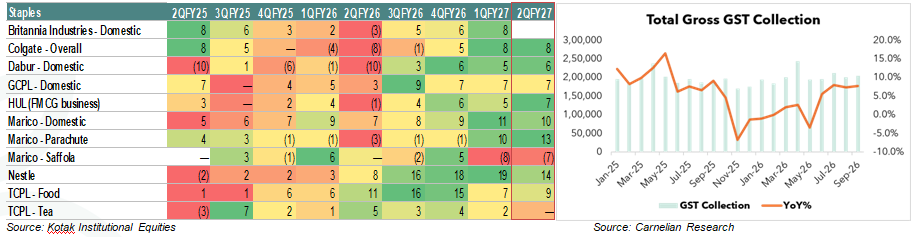

Source: Kotak Institutional Equities
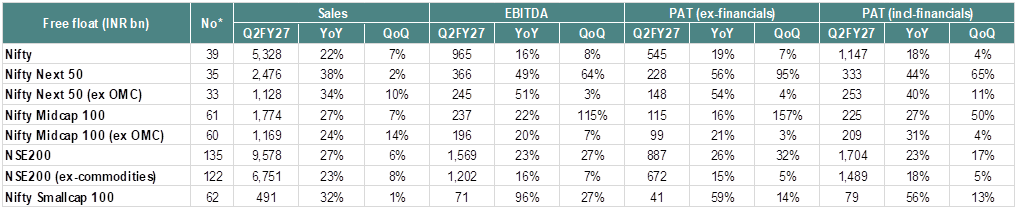
Source: I-Sec Research
So why did the market fall?
If the economy did this well, why did the index fall? Because in the short run, prices are driven by forces that have little to do with the businesses underneath: FII flows, US interest rates, tariff threats, currency moves and geopolitics. That is exactly what happened this year.
From last Samvat to this one, foreign investors (FIIs) sold roughly ₹4 lakh crore of Indian equities. The reasons had little to do with India:
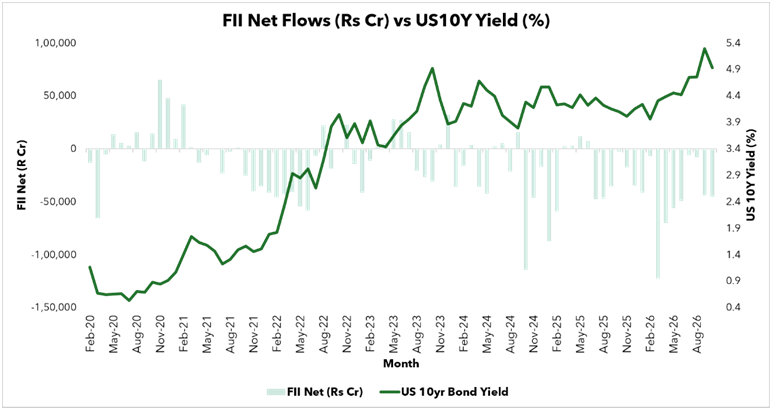
Source: Carnelian Research
Domestic institutions (DIIs) bought Indian equities every single month, investing about ₹7.1 lakh crore in last Samvat, close to double what FIIs sold. DII ownership of Nifty 500 companies rose to a record ~21% in June 2026, while FII ownership fell to a record low of ~17%.
For the first time in India’s market history, domestic money, not foreign money, is the dominant force in Indian equities. And it showed up exactly when it was needed.
We have seen this before
If we go back to our memories in 2022, when Russia Ukraine war started, oil crossed $100 a barrel and FIIs pulled a record ₹1.98 lakh crore out of Indian equities. The Nifty fell as much as 17% from its peak. DIIs absorbed almost the entire blow, buying ₹2.56 lakh crore.
Sentiment was similar to recent times of pessimism. Our note Build this vintage highlighted the opportunity. Ukraine war is still not over, but 2023 and 2024 turned out to be one of the best year of returns.
That reversal was the opening act of the bull run: the Nifty rose about 19% in CY2023 and 9% in CY2024, while small caps gained over 47% in CY2023 alone.
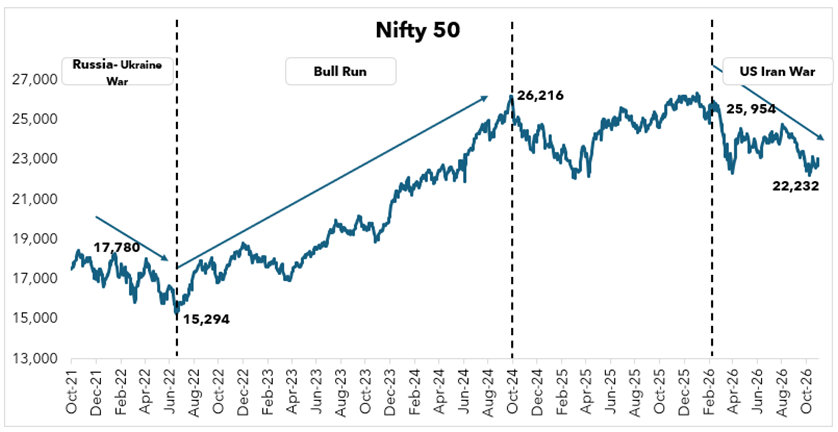
Source: Carnelian Research
This time the shock wore different clothes: an Iran war instead of Ukraine, an AI-driven index reshuffle instead of outright panic. But the pattern is the same. An external shock, a wave of FII selling, DIIs holding the line, and a market that looks dull in the moment while quietly setting up for what comes next.
Our view for the next 2–3 years
Looking beyond the next few months, we are optimistic. Credit, consumption and investment are now moving together, a combination that tends to support a multi-year earnings cycle. India will lead the world in growth which coupled with unleveraged balance sheet, private sector capex and consumption picking up will be structural drivers over next few years. We expect earnings growth to drive returns from here, and that is the healthier kind of return. Steady domestic savings flowing into equities give the market a strong base, and foreign investors will return as global conditions settle, that would be an added tailwind rather than a requirement. There will be volatile stretches along the way. But over the next two to three years, we believe improving fundamentals and reasonable valuations make today a good starting point for patient investors.
The risks we are watching
We are in the business of taking risk. But you can only manage a risk once you know where it comes from. Today, the key risks to our view are largely external:
We track each of these closely. So far, they have hurt sentiment far more than they have changed the direction of India’s domestic growth drivers: credit, consumption, investment and earnings.
Why Samvat 2083 looks brighter
A year ago, the market was expensive and the news was good. Today, valuations are reasonable and the news is bad.
For long-term investors, the second is usually the better starting point.
A year ago, the Nifty 50 and Nifty 500 traded at a one-year forward PE of 24 and 26 respectively. Today, they trade at 19 and 21 times. A good part of the bad news is already in the price. Meanwhile credit, consumption, investment and earnings are all moving in the right direction.
Nobody can predict when foreign money will return. But history shows it tends to come back when growth is strong and valuations are fair, and today both are in place.
Hanuman’s ocean never got smaller; he simply remembered his strength. India’s strengths, from credit and consumption to investment, earnings and a deep pool of domestic savings, have not gone anywhere. They have only been drowned out by the noise.
As Benjamin Graham put it:
“In the short run, the market is a voting machine, but in the long run, it is a weighing machine.”
This year, the market voted on headlines. Over time, it will weigh fundamentals.
Diwali falls on Amavasya, the moonless night. But the moon has not gone anywhere, it is still there, only hidden from our view by its position between the earth and the sun. After a few days, it returns. India’s strength is the same: it has gone nowhere; it is only hidden from view by the noise. That is why we light diyas on the darkest night.
We believe Risk reward of investing in India are significantly favourable. We are quite confident next Diwali won’t have similar outcome as this one but more importantly this vintage will give great outcome over a 2-3 years period.
Wishing you and your loved ones a happy Diwali and a prosperous Samvat 2083.