
Greetings from Team Carnelian!!
We consistently overestimate technology’s disruptions and perpetually underestimate the adaptability of human beings.
On 21st December 2015, Elon Musk made a precise and confident prediction: Tesla vehicles would achieve full self-driving capability within two years. By 2017, your car would drive itself. That same year, a Morgan Stanley analyst published a landmark report projecting complete autonomous vehicle capability across the industry by 2022 — and mass market penetration by 2026.
It is now March 2026. Most jurisdictions on earth still do not permit fully driverless commercial vehicles. The technology is real, and it is advancing. But the statement made just ten years ago — has missed its deadline by years and counting.
In 2021 when Fintech disruption was at its peak, the common question was will Banks be disrupted by fintechs. Due to this fever, banks were most disliked sector of the year. Banks are still thriving and growing while adapting to new technologies.
These are not an isolated failure of forecasting. It is the pattern. And the pattern is repeating today — with AI reshaping IT services, entire industries, and the jobs of millions.
On 5th February 2026, Anthropic released Claude Opus 4.6, a significant update to their flagship artificial intelligence model designed to enhance coding, agent coordination, and enterprise workflows. Within three weeks, hundreds of billions of dollars were wiped from the market capitalisation of global IT services companies. The narrative: AI will automate everything, eliminate IT jobs, and render IT service providers obsolete — catastrophically and significantly.
Financial markets periodically encounter technological shifts that appear disruptive rather than transformative — the internet in the late 1990s, cloud computing in the 2010s, digitization around 2015. Each created an opportunity larger than the threat. We believe AI will follow the same arc — with one critical difference. This time, the stakes are higher, the speed is faster, and the opportunity is larger.
As per a recent McKinsey survey, more than half of enterprises are piloting agentic AI and plan to invest significantly over next 6 months and The majority of them plan to increase both total and outsourced IT spending. While AI may disrupt 20% of existing core work but it will also create immense new opportunities.
In this letter, we will be direct about both the risks and the opportunities of AI.
Before getting into our view, let us address the first principle of what is happening within the Technology stack.
Whenever new technology emerges, new applications get built on top of a new computing platform – a process known as Platform Shift. Similar shifts occurred before, driven by PCs, the internet, smartphones, cloud computing and digitization. Each time the computing stack was reinvented, new kinds of applications were created.
So, shall we see AI as transformation or disruption?
Until now, software in the past was effectively “pre-recorded.” Humans would write the algorithm — the recipe — for a computer to execute. Traditional software was designed primarily to process structured information. SQL became one of the most important foundations of enterprise software, and almost everything ran on it.
Now, we have AI that can look at an image and interpret it, read text and understand meaning, listen to sound and understand context, and then reason about what to do. Now the computer is not only executing pre-recorded instructions — it is processing information in real time, taking in context and environment, understanding intent, and performing tasks based on that intent.
For the first time, an intelligence layer has been created — what we call Artificial Intelligence — shifting computing from rule-based execution to contextual reasoning.
AI is not a simple, self-contained technology where one merely builds an application on top. It is a five-layer technology stack, comprising:
- Energy – AI demands continuous and enormous energy to operate in real time.
- Chips and Computing Infrastructure – Specialized semiconductor chips and hardware that power AI computation.
- Cloud Infrastructure and Services – Delivers computing power and storage at global scale.
- AI Models – Large models that process vast data and deliver results at unprecedented speed.
- Applications – the layer where economic benefits ultimately show up, across industries like financial services, healthcare, manufacturing and others.
While hundreds of billions — likely trillions — of dollars are being invested across the first four layers, most discussion focuses narrowly on the AI model’s layer. But models cannot exist without the infrastructure beneath them. And the most important layer — the one that will define real economic impact — is the application layer on top.
Technology discussions are interesting. But markets ultimately care about real productivity gains. History has seen numerous transformations, and as always markets initially have focused more on technological disruptions vs opportunity it creates.
Let’s understand this with more examples,
When Railroad was introduced, there was huge fear amongst public, and they were convinced trains would destroy human health, livelihoods, and society. Governor Martin Van Buren of New York wrote to the President: “Railroad carriages are pulled at the enormous speed of 15 miles per hour by engines which, in addition to endangering life and limb of passengers, roar and snort their way through the countryside, setting fire to crops, scaring the livestock and frightening women and children”.
Another example, The Textile Machinery, where textile workers – weavers, croppers, and knitters across England — were absolutely convinced that the introduction of power looms and knitting frames would permanently destroy their livelihoods.
Closer to home, when Dematerialisation (Demat) was introduced in India, the fear was equally loud. Brokers, sub-brokers, and the entire network of physical intermediaries were convinced that digitalising share certificates would render them obsolete overnight.
We already know how these stories ended. Is it not remarkable that humanity feared, at the outset of each transformation, what turned out to be one of the greatest leaps forward it had ever made.
Two hundred years later, we are sensing the same fear around us. By now, most of us have encountered claims that AI represents an “economic pandemic” leading to massive job losses — output that benefits the owners of compute but never circulates through the human consumer economy.
But reality is far more complex. Mission critical systems run on multi-decade architectures, strict compliance requirements, and deep integrations, making system integrators and AI-native companies essential for implementation, governance and deployment at the application layer.
McKinsey in their recent report “Reimagining the value proposition of tech services for agentic AI” has highlighted
Enterprises are seeking support to navigate the complexities of adopting a joint human–agent operating model, and technology services providers are well positioned to play a critical role. If approached strategically, agentic AI could become a net positive for the sector, potentially driving an additional 3% points of annual growth and unlocking $100 billion to $400 billion in incremental spending by the end of the decade.
While AI may achieve significant productivity gains and bring more technology management in-house, the core business of technology services providers could face a 20-30% contraction.
However, with the emergence of agentic AI, the total tech services market is expected to grow by 4-7% annually over the next five years, reaching $1.6 trillion to $1.9 trillion by 2030, outpacing the previous, pre–gen/agentic AI estimates of 4-5% CAGR.
Majority of enterprises expect to increase both total and outsourced IT spending over next years because of Agentic AI.
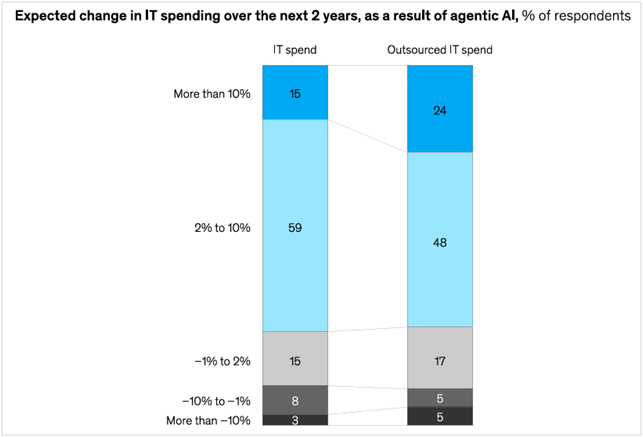
Source: McKinsey
Infosys at their latest investor day and AI summit highlighted Modernization of legacy systems that cannot be deferred. Significant data engineering to be done to enable productive AI implementation.
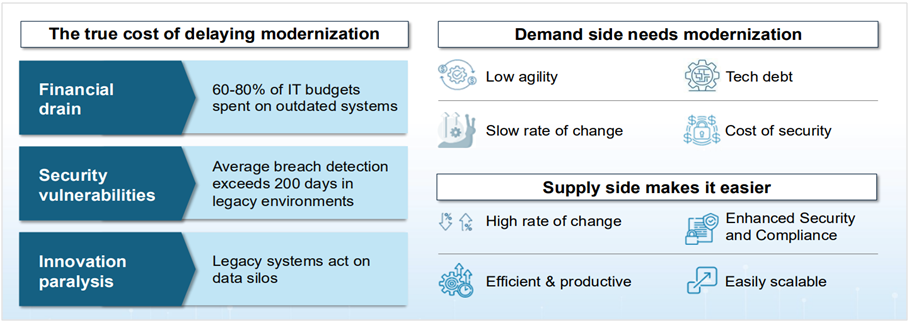
Source: Infosys
In the rapidly changing environment, every firm must evolve themselves and years of tech debt must be paid. Surprisingly, foundational technology is ahead of its diffusion and deployment. Where AI progress is outpacing enterprise readiness.
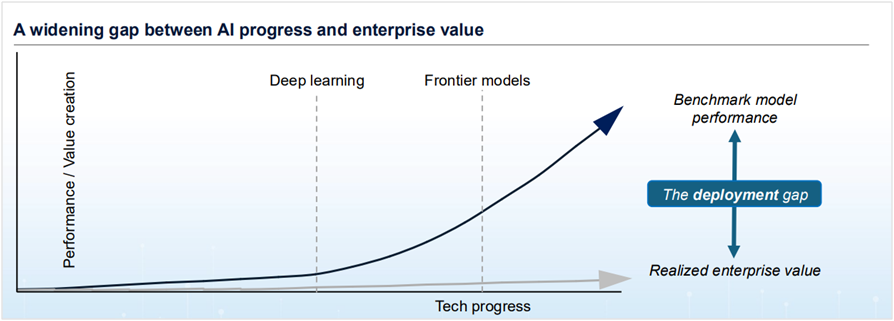
Source: Infosys
AI and job losses: Narrative or reality
There is, another fear — one that keeps markets and minds anchored in fear rather than focused on what comes next – Will AI take my job? The narrative is loud and everywhere: millions of jobs are exposed, productivity will rise, and less manpower will be required.
The framework that resolves the employment debate is simple: distinguish between the purpose of a job and the tasks that job requires. Automation of tasks expands the capacity to fulfil purpose — and expanding purpose creates more employment, not less.
Ten years ago, radiology was the profession most confidently predicted to be eliminated by AI. Today, AI has transformed every aspect of radiology — and the number of radiologists has increased. More scans read meant more diagnoses, more patients treated, more hospital revenue — and more radiologists hired. The same dynamic is replaying across nursing, legal research, financial analysis, and software engineering.
Did the advent of SAP/Oracle ERP replace finance & operation teams or expand them?
Technology created more productive opportunities faster than it eliminated old ones. The fear is real. But so is the evidence. Past transformations did not shrink human prosperity — they expanded it, creating jobs and driving wages upward in most cases.
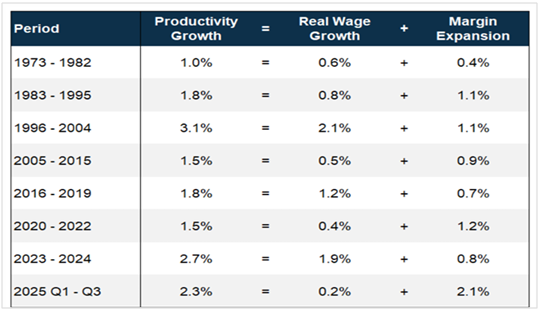
Source: Julius Bäer
Current data on AI tells a different story. Job posting data showing that demand for software engineers is actually rising rapidly, up 11% year over year in early 2026.
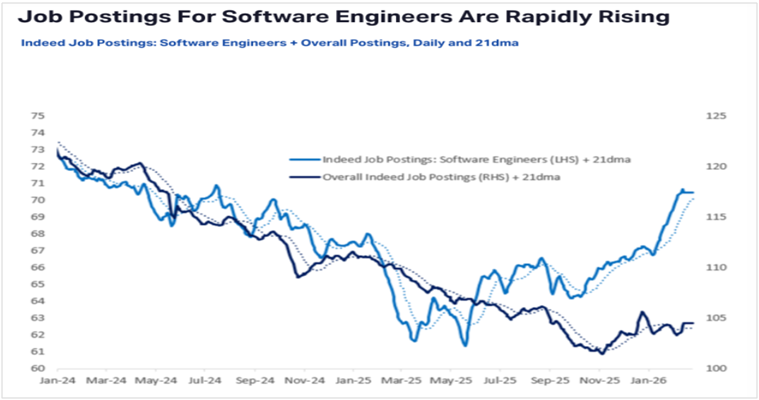
Source: Citadel
While AI will gradually introduce non-linearity in workforce structures, critical enterprise processes will still require human monitoring and decision-making by professionals to ensure accuracy, compliance, and accountability.
While disruption and job losses are inevitable, every transformation brings new opportunities. We believe we are at the dawn of a period marked by both challenges and potential.
Emerging Trends and Sector-specific highlights:
Health care and life science
- Drug Discovery: AlphaFold cracked protein structure prediction — biology’s hardest fifty-year problem — in eighteen months. AI is compressing drug discovery and cost.
- Clinical Research: AI-generated hypotheses and synthetic data are redesigning clinical trials from the ground up. Trial design timelines are shrinking from years to months.
- Diagnostics: AI imaging models match or exceed specialist radiologists in accuracy for cancer detection, retinal disease, and pathology. For the first time in history, every rural primary health centre in India can now access specialist-grade diagnostic intelligence.
Financial Services
- Credit Underwriting & Fraud detection: AI models assess thousands of variables — transaction behaviour, digital footprint — in milliseconds.
- Regulatory Compliance: A $270 billion annual global cost — documentation, monitoring, reporting, audit trails — is being automated through AI-assisted compliance systems. Regulatory risk is reduced. Compliance teams are redeployed to judgement-heavy oversight instead of repeated tasks of manual data entry and document scanning.
- Risk Modelling: Market risk, credit risk, and systemic risk models running on AI can process far more variables, at far higher frequency, with far greater sensitivity to non-linear dynamics than any prior generation of financial models.
Manufacturing & Services
- Predictive Maintenance: AI models trained on sensor, vibration, and thermal data predict equipment failure before it occurs.
- Quality Inspection: Computer vision models inspect at speeds and resolutions impossible for human operators — detecting micro-fractures, surface defects, and assembly errors invisible to the eye.
- Supply Chain Intelligence: AI-optimised logistics routing, demand forecasting, and inventory management are compressing working capital requirements and reducing supply chain disruption costs.
- Digital Twin Technology: AI-powered digital replicas of physical factories allow operators to simulate process changes, test configurations, and optimise throughput
How India is placed in this transformation journey:
India enters the AI era with the world’s most ambitious digital public infrastructure — Aadhaar (1.4 billion biometric identities), UPI (the world’s largest and most economical real-time payments network), ONDC (open commerce), and DigiLocker (digital credentials). The India AI Mission now sits on top of this foundation, adding sovereign intent to an already powerful stack.
AI needs data at a scale. India has data at an unprecedented scale — and the regulators will have to deploy it productively. As Prime Minister Modi himself has articulated, “India not only develops new technology but also adopts it rapidly — and in AI, India sees both opportunity and the blueprint of tomorrow.”
India’s demographic dividend is becoming an AI dividend. With a median age of 28 against Japan’s 49, China’s 38 and Germany’s 45, a deep STEM pipeline, and an enterprise data moat built over decades, India’s structural advantages are real and compounding.
But advantages alone do not determine outcomes. The edge is clear — but the imperative is equally clear: move faster, adapt continuously, learn relentlessly, and execute with urgency.
To Conclude: There is one word that separates two very different futures. That word is transformation. When people say ‘disruption,’ they imagine a new technology arriving and erasing what existed. When history speaks, it tells a different story: technologies transform industries. They do not erase them. They expand them. They upgrade them. They create new roles, new value pools, and new winners — while rendering certain old models obsolete.
We believe disruption over the next couple of years is inevitable — but so is the immense opportunity that will emerge from it. We are closely watching emerging trends, learning about new threats and opportunities every day.
This transformation is best viewed not through the lens of fear, but through the lens of optimism and opportunity.
Annexure: What veterans have to say on AI
Speed plus Scale – India’s honorable PM Narendra Modi
‘AI will not be a monopoly, but a multiplier.’ AI multiplies human capability, It does not replace human purpose. The firms and individuals that understand this position themselves as directors of AI rather than competitors to it — will compound their value in this era.
Speed plus scale unprecedented AI is transformational if driven in right direction. It is very difficult to gauge real picture when we are in transformational era. AI will increase human capability multifold GPS shows us direction, but human decide where they want to go first.
The Tech Debt Supercycle — Nilekani’s Insight
As Nandan Nilekani, Co-Founder of Infosys, has stated directly: ‘Business cannot be run in old ways. Modernization of legacy systems cannot be deferred anymore.’ For decades, enterprise IT spending ran 60–70% maintenance and 30–40% development. In the AI era, this flips. AI handles routine maintenance. Human talent shifts entirely to development, transformation, and design — higher-margin, higher-value work.
Decades of accumulated tech debt — legacy COBOL systems, siloed data architectures, undocumented workflows — must now be paid. This is not optional. It is the price of AI adoption. and it represents a multi-year, high-value modernization Supercycle that is already beginning. Technology is ahead of enterprise ability to deploy it. IT services bridge that gap. This is immediate, concrete revenue — not a future hope.
AI without domain knowledge is science experiment — Sudhir Singh, CEO, Coforge
“Generic AI is a commodity. Applied AI is a monopoly. AI without domain knowledge is a science experiment. AI with domain knowledge and industry expertise is a business case.”
Services will not disappear — they will be recomposed. The goal shifts from delivering software to solving business problems. The pivot is from pure developer to domain expert and workflow designer. The value proposition evolves from providing staffing to providing cognitive infrastructure. The firms that make this transition will not just survive, They will command premium economics.
Jensen Huang, CEO of Nvidia: “You’re not going to lose your job to AI, but you’re going to lose your job to someone who uses AI”. He believes AI will drive productivity, revenue growth, and ultimately more hiring — but only for those who embrace it. “The most important layer — the one that will define real economic impact — is the application layer on top.”
Dario Amodei, CEO of Anthropic: “My basic prediction is that AI-enabled biology and medicine will allow us to compress the progress that human biologists would have achieved over the next 50-100 years into 5-10 years.”
Sam Altman, CEO of OpenAI: “We’ll find new kinds of jobs, as we do with every tech revolution. But I would expect that the real impact of AI doing jobs in the next few years will begin to be palpable.”
Sundar Pichai, CEO of Google: “People who learn to adopt and adapt to AI will do better. It doesn’t matter whether you want to be a teacher, a doctor — all those professions will be around, but the people who will do well in each of those professions are people who learn how to use these tools.”